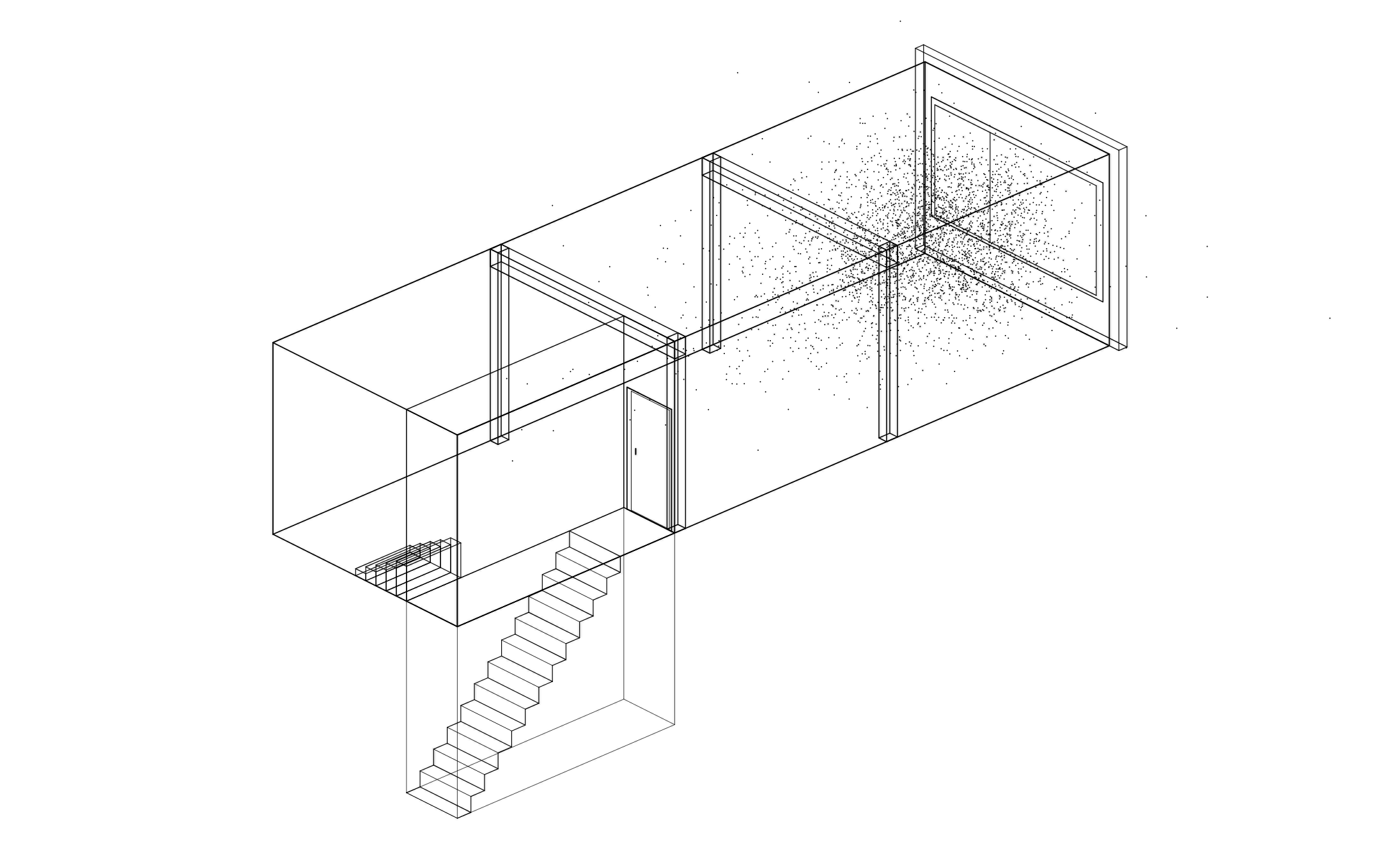
Will we see through the future, or hear it coming?
Will we see through the future, or hear it coming? is a room full of WiFi that can feel a body and turn it into an audiovisual piece. ESP32 boards send signals to each other all night, a small parliament of circuits in permanent session, and every body that comes in changes the signal and becomes sound and image. No camera, no microphone. Nobody is watching; the room is simply paying attention. From this, the installation asks: what if it is not only an art project? What if, some ordinary Tuesday, mass surveillance through WiFi gets applied, and the corporation behind it benefits, as corporations do? In the fiction, the artist founds FireWire Corporation and in 2036 sells it to XYZA Inc., a big tech company from the techno-military complex. In 2046, an activist writes a worm to attack it. Four pieces lay the story along one line: a business card (past to present), the audiovisual piece (present to future), merger papers (future) and a game (future and beyond).
01 About
A room full of WiFi that nobody can connect to. Small boards whisper to each other all night, like insomniac neighbours through a thin wall. When someone walks in, their body bends the conversation into audio and visual.
In another timeline, the artist, Wasawo Somnus, turns the room into a company and sells it to the techno-military conglomerate, which is how these stories tend to end; until, years later, hacktivists send a worm in after it.
The timeline unfolds with business cards, four screens, merger papers, and a game. The room goes on counting whoever stands in it, patiently, the way rooms do.
02 The room
The room is full of WiFi that nobody can connect to. There is no password. There is no network name to squint at on your phone, no small cafe hope. Small circuit boards (ESP32s, about the size of a stick of gum and not much more expensive) send signals to each other all night and write down how each one arrives, across 52 subcarriers, which is to say 52 slightly different ways of saying the same thing. When the room is empty, the pattern is steady, almost devotional. When a body comes in, the pattern changes, because a body bends radio. You are, it turns out, a weather event. The installation catches that change and turns it into sound and image, on four screens and six speakers. There is no camera and no microphone. Visitors play the piece just by being in the room, whether they mean to or not, the way one plays a part in a crowd, or in a statistic.
From here the work asks: what if this is not only an art project? The same WiFi already hums in every hotel, mall, lobby and clinic, in the ceiling, behind the potted ficus, under the soft music nobody chose. What if it becomes real in the future, where mass surveillance through WiFi gets applied, and the corporation behind it benefits, and the benefit is reported quarterly?
03 The fiction
So the installation sets the audiovisual piece beside a speculative fiction of how this could turn out, told the way a company tells its own history: in objects, in paperwork, in things that outlast the people who signed them. The four pieces in the room run along one line, from what everything stands on to what comes after it:
Past to present
business card
The artist becomes the founder of FireWire Corporation, a record label first, and then, a few years on and without anyone being told, a presence-sensing company grown out of the ceilings the label left its boards in, like a shop that sells umbrellas and also, quietly, the rain. There is one card, in one version, printed before there is anything to show and never reprinted. Everything after it stands on it. Every empire starts as a small rectangle of good paper. The exhibition is the company's first Room.
Present to future
main piece
Four screens and six speakers in the middle of the room. It happens every night, now, while you stand there, and one of its panes is already predicting what comes next, with the calm confidence of a horoscope that has seen your bank statements. This is the part that could become real.
Future (2036)
M&A papers
The company is sold to XYZA Inc., a big tech company from the techno-military complex, for US$ 1.48bn, a number with the strange serenity of all very large numbers. Seven documents in an acrylic frame, one leaf each (term sheet, letter of intent, diligence list, merger agreement, disclosure schedule, founder agreement, occupant purchase agreement: a litany best read aloud, in a low voice, in a parking garage) show the financial engineering behind the deal: futures on how many people are in a room, swaps that let venues hedge their footfall, and a retail programme that sold people a share of the room they were standing in. Ownership, at last, of your own presence, payable in instalments.
Future and beyond (2046)
game
An activist writes a worm to attack the company. The worm is small and patient, as worms are. The player guides it through XYZA's mainframe, using their own body as the controller, so the body that was being counted is, for once, the one doing the steering. The people in the gallery appear in the level as the mainframe sees them: as weather, as numbers, as guests who never signed in.
Read in order, the room travels from what was already there to what comes after it, the way a river might read its own delta. A CD sold at the end of the show is the record of the room: an obsolete format holding a future that has not happened yet. Please keep the receipt.
| Acquirer | XYZA Inc. |
| Target | FireWire Corporation |
| Price | US$ 1.48bn |
| Documents | 7 |
| Instruments | Footfall futures, venue swaps, retail shares of the room |
04 Inspiration
When I told Roma about the idea, he laughed and said: don't give them (the corporations) the idea. It was a joke. Most good warnings are.
And yet I have been thinking about it lately, mostly with "The Universal" by Blur playing somewhere in the back of my head, a song that keeps insisting, very politely, over strings, that yes, it really, really could happen.
The song also ends by suggesting, maybe to me personally, that when the days seem to fall on you, you should just let them go. I am trying. The days are heavy, and some of them come with term sheets.
These ideas came together, the way unrelated things do at three in the morning. I want to joke about it with my work: if it does happen, this is what the finance will be. With the business card, the papers and the game, I try to theorise and imagine what could possibly be played out with financial engineering, along with all the merger and acquisition stuff, which is, I have learned, a genre of literature with very long sentences and no endings, only closings.
References
- Blur (1995). “The Universal.” The Great Escape. Food / Parlophone.
05 Visit
Badwater Project Room, Bangkok
From 28 October 2026, for around two weeks, Tue–Sat, 18:00–24:00
Opening Wednesday 28 October, 18:00–22:00. Closing date to be announced
- I Business card. Past to present. On the stainless wall shelf.
- II Main piece. Present to future. Centre of the room, four screens, six speakers.
- III M&A papers. Future, 2036. Inside the acrylic frame.
- IV Game. Future and beyond, 2046. Its own screen.
06 Poster
07 Credits
- Producer
- Anupas Premanuwat
- Project manager
- Yves PokakunkanonNatthamon Wijarn
- Installer
- Korrawit ThansaoPoramet PrommaSutiphong SudsangAnupas Premanuwat
- Room survey and 3D model
- Paaroon Chuprasert
- Installation 3D mockup
- Yves Pokakunkanon
- Installation consult
- Pasuth Sa-ing thong
- M&A paper consult
- Pongkhun Phanaryuwattana
- Web design
- Wasawat Somno
- Poster design
- Wasawat SomnoAnupas Premanuwat
- Special thanks
- Sippapas ThienwiwatNanut ThanapornrapeeElaine SunThanapat Ogaslert